Enquiry Form
LIMS for Food & Beverage Industry: Ensuring Safety and Quality Control
The food and beverage industry operates under intense pressure and has a high level of regulations, where achieving a quality breakdown can cause recalls of products, fines, or reputational damage that extends well beyond the immediate case. The manufacturers will need highly sophisticated systems to manage their quality procedures as the consumer expectations of safety and transparency continue to increase. Laboratory work has also been streamlined and made to be very easy, as a Laboratory Information Management System (LIMS) has become a necessary system in food safety, compliance, and the entire production chain.
What is LIMS in the Food & Beverage Industry?
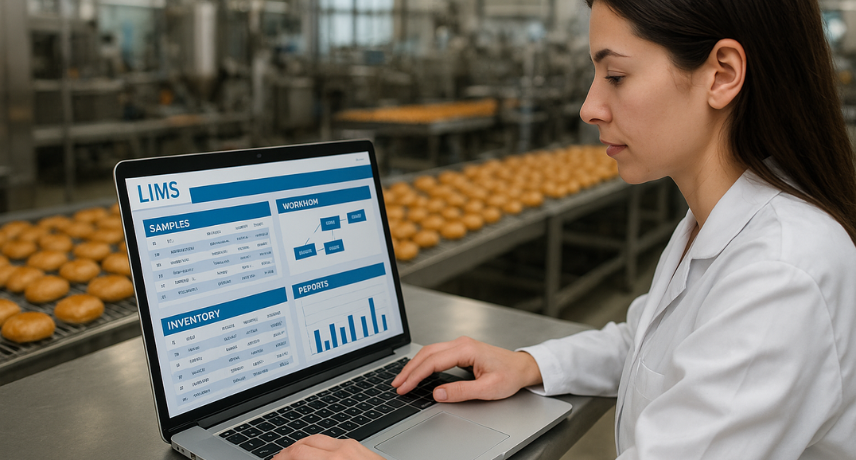
Laboratory Information Management System is an advanced software application that is used to manage, track, and better laboratory operations and data. In the food and beverage industry, LIMS is a central repository for all testing, from raw ingredient testing to testing for finished products. LIMS can track samples, visit tests, store analytical data, and generate detailed reports that can be submitted for compliance with food safety regulations.
Some of the most modern LIMS systems can integrate with laboratory instruments, ERP platforms, and quality management software so that they create a single ecosystem, eliminating data silos and not having to rely on manual efforts. Integration allows every data point—from microbiological tests to nutritional assessments—to be captured and validated in real time.
Key Challenges in Food & Beverage Quality Control
The Complexity of Compliance Regulations
Navigating the myriad of regulations applicable to food manufacturers is no simple process. The U.S. food industry must deal with FDA regulations, FSMA requirements, HACCP plans, and different ISO standards around the globe, including ISO 22000. Each regulation has specific requirements for documentation, traceability, and response time. Product quality regulations are changing so rapidly that it is hard to keep up using only manual systems, assuming you can even maintain compliance.
Traceability and Recall Challenges
In the event of contamination or a question about an ingredient's quality, manufacturers need instant access to the complete track and trace histories for products. When product tracing is done with paper-based systems or siloed databases, addressing potential CRPs or "tracebacks" can be a long process that is cumbersome and error-prone. Efforts associated with a recall can increase and result in greater financial pain due to more product being pulled than is ultimately necessary.
Data Integrity & Audit Readiness
Regulatory audits require documentation to be completely airtight, and data must be maintained in compliance. Handwritten logs, spreadsheets, and stand-alone systems create the opportunity for errors due to transcription, loss of data, and instances of non-compliance that lead to warning letters or facility closures.
Testing and Turnaround Times
Bottlenecks in laboratories impact production schedules. Manual handling of samples, paper-based sample request forms, and delayed reporting of results create inefficiencies that delay time to market and increase costs of inventory holding
How LIMS Transforms Food Safety Management
The LIMS program does away with the anticipated manual tracking of samples by automatically generating unique identifiers, safeguarding their chain of custody, and routing them to the correct testing queue. The use of barcodes or RFID technologies guarantees that samples will not be misplaced or relabeled; automated prioritization guarantees that urgent testing will be done on demand; and the LIMS system records storage conditions and expiration dates, reminding personnel when samples are to be thrown away or retested.
Complete Testing Workflows
The platform builds protocols into workflows to guarantee testing is consistently carried out by technicians using validated methods. LIMS automatically computes results, applies specification limits, and flags out-of-specification results for investigation. The integration of your LIMS with laboratory instrumentation avoids transcription errors and speeds access to results.
Monitoring Quality in Real Time
Dashboard visualizations can instantly visualize the status of testing and testing metrics, and trends over time. Quality managers can see KPIs and adjust accordingly to address potential issues before impacts are realized. Real-time alerts notify captive stakeholders when results are outside of acceptable values, allowing for action to be taken quickly regarding potential safety-related issues.
Complete Traceability and Documentation
LIMS provides an unbreakable link of documents starting from the raw material receipt and ending with the distribution of finished products. It connects every test result to particular lots, batches, and production runs, thus speeding up the investigation of traceability. In the event of a recall, manufacturers can immediately spot the products, the channels of distribution, and the customers affected, thus reducing the recall area and safeguarding public health.
Regulatory Compliance and Audit Support
The system is always creating audit trails that make it difficult to see who did the action, when it was done, and if any changes were made. The electronic signatures used comply with 21 CFR Part 11, thus making sure that the data is both reliable and real. The use of customizable report templates allows for the instant generation of compliance documents, which in turn changes the audits from being stressful to providing routine demonstrations of quality recognition.
Essential LIMS Features for Food & Beverage Operations
Nutritional and Chemical Analysis
Nutritional labeling, allergen testing, pesticide residue analysis, and heavy metal detection with automatic specification checking are efficiently carried out through built-in databases.
Supplier Quality Management
The vendor certificates of analysis are tracked, the approved supplier lists are managed, and supplier performance is monitored through trend analysis and scorecards.
Shelf-Life and Stability Studies
The expiration date and storage guidelines are established by protocol design, testing interval scheduling, and degradation pattern analysis.
Multi-Site and Multi-Laboratory Support
The data from different locations can be centralized, and site-specific configurations can be retained, thus providing the entire company with quality visibility and standardization.
The ROI of Implementing LIMS
The ROI of Implementing LIMS It's a common scenario for organizations that implement LIMS to enjoy reductions in testing times of 30-50%, enhancements in lab productivity of 25-40%, and massive drops in costs related to compliance. In addition to these quantifiable efficiencies, LIMS secures the reputation of the brand by not allowing quality to escape and by being capable of quickly responding to developing events. The system's data analytics part shows the way to opportunities for process optimization, ingredient substitution, and supplier consolidation that would result in ongoing cost savings. Maybe the most significant thing is that LIMS moves quality control from a small area to a huge area where it becomes a strategic asset that sets apart brands in the markets for competition.
Future-Proofing Your Quality Infrastructure
Ahead of the Curve on the Quality Infrastructure.
With the digital transformation of the food industry, the LIMS platforms are being changed to include artificial intelligence, predictive analytics, and cloud-based architecture. Such innovations make it possible to monitor quality predictively, conduct root cause analysis in an automated manner, and collaborate with the global supply chains.
By investing in a modern LIMS, food and beverage manufacturers will be in a position to address the future needs and handle the present-day challenges. The system is easily scaled along with the growth of organizations, new testing methods are easily accommodated as they come up, and the system flexes with changes in regulations as they arise.
Make the Next Move into Quality Excellence.
Food safety management is a complicated process, which requires advanced equipment that corresponds to the size of the operations in the present day.
Willing to transform your laboratory practices? Contact Software in Demand now to find out how our state-of-the-art Laboratory Information Management System can safeguard your brand, make operations lean, and guarantee the consistent maintenance of high food safety standards. Our highly skilled people will make you a design that matches your individual problems and goals.
Old systems do not ensure that your reputation is not in danger. Collaborate with Softwares in Demand and enjoy the trust of having the technology of world-class quality management.